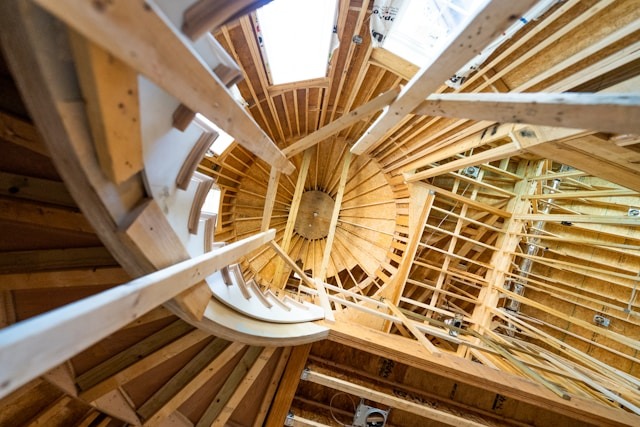
Today’s framing of residential homes would be classified as “Western Deck Framing” or also referred to as “Stick Framing.” Overall, independent sections/parts of the frame are connected through load paths, which transfer from their origin all the way to the footings that support the foundation. Because sections of the frame are being done in smaller units, efficiency and accuracy can be achieved by an experienced builder. What is attractive with this approach to framing a structure is that a relatively smaller crew can perform this task. I have framed homes solo, which can raise eyebrows when I mention this fact. One of the real strengths of Western Deck Framing is that extra attention can be focused on point loads, girder connections, and component sections, which can be generously connected to one another.
In the 1920’s, America began depleting its taller trees, and western deck framing was developed and honed over the next decades. Western deck framing eliminated balloon framing, which combined sections of the building as one. Typically, a two-story facade was constructed and raised into position. Although balloon framing does have a degree of efficiency, there are a lot of negatives when approaching a framing project in this manner. The main issue is the weight of setting a wall of this magnitude. The other negatives include floor-to-wall connections and, especially, fireproofing.
I generally work on a combination of timber-framed, balloon-framed, and Western Deck-framed homes. The Timber and Ballon framed homes require a lot more work because the system and standards of yesterday will not meet today’s codes. Therefore, I generally end up reframing a section of that area to transfer live and dead load to a foundation, which may or may not have a footing. The other issue associated with balloon-framed homes is insulation, fire stopping, and out-of-level, plumb rooms.
It’s more common in my area to find a hybrid timber-framed and balloon-framed building, which has similar issues but suffers more failures than a typical generic balloon-framed building. Generally, the hybrid of the combination between timber and balloon can yield some shocking discoveries in which the structure was utterly compromised. This type of scenario is likely from a remodel or a plumber retrofitting the house for a bathroom.
I strongly urge consumers to find reputable remodeling contractors without a fictional background in framing to work on their homes. Framing experience is gained by doing the work as opposed to watching YouTube videos.
Please consider American Building & Design for your next remodeling project.
